




Fermented foods have a long tradition
Not all microorganisms are harmful to humans. Many species occur naturally in foods, on our skin, or in the human body. In fermented foods, microorganisms such as bacteria or yeasts perform important tasks during fermentation. Which living microorganisms, vitamins, minerals, or other fermentation products are actually contained in the final product depends heavily on the respective food and manufacturing process.
You probably already know various fermented foods from your everyday life:
For example:
- Kombucha
- Kefir
- Kimchi
- Yogurt
- Miso
- Sauerkraut
- Various types of cheese
What happens during the fermentation of foods?
Humans have been fermenting foods for many hundreds of years. In the past, fermentation was an important way to preserve food and build up supplies for the cold season. Which nutrients and living microorganisms are present, and how long a fermented food will keep, depends on the respective product and manufacturing process.
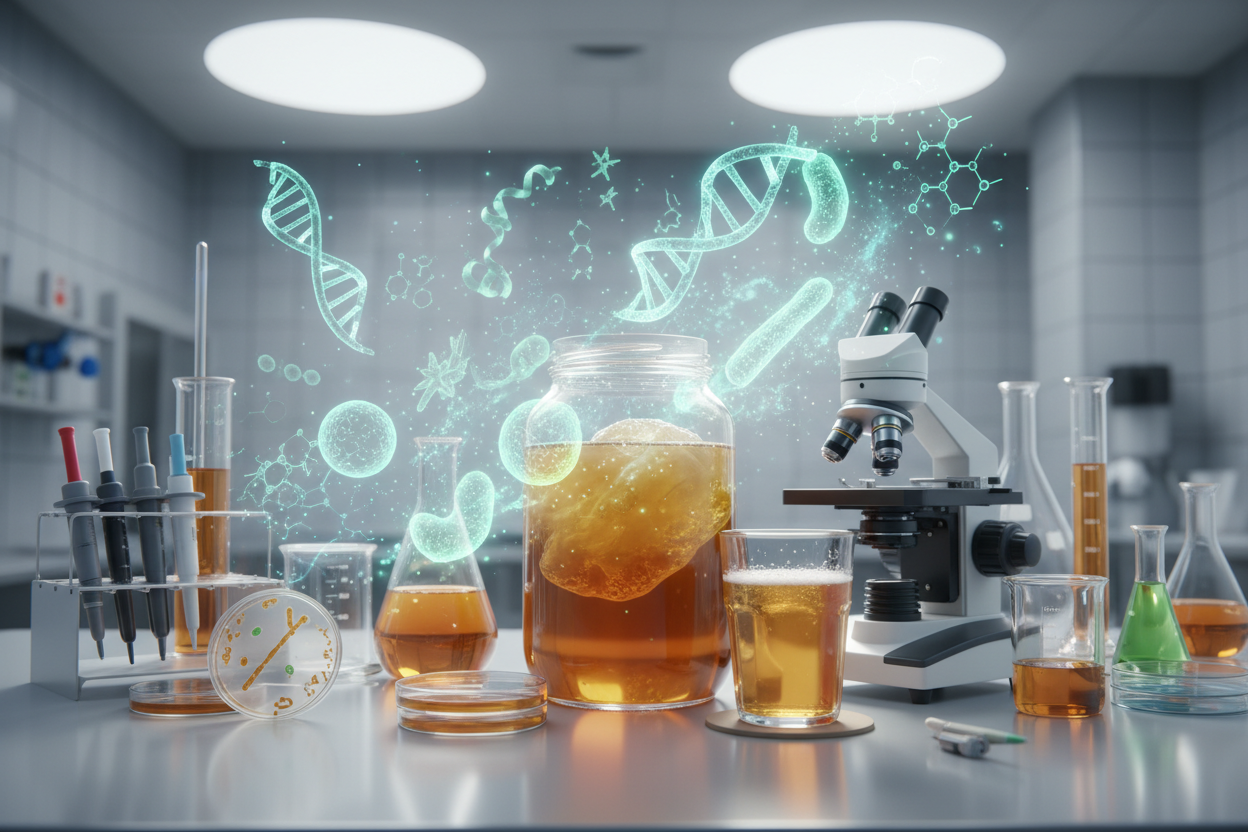
The fermentation of foods and beverages, such as kombucha, is based on natural conversion processes. If you look more closely at the process of fermentation (fermentation), certain components of the food, including sugar and other carbohydrates, are broken down with the help of enzymes and microorganisms and converted, for example, into organic acids, gases, or alcohol.
Which substances are produced in the process depends on the microorganisms involved and the conditions during fermentation. Some fermentation processes can take place under low-oxygen conditions, while others require oxygen. Lactic acid bacteria, for example, play an important role in the fermentation of sauerkraut. Yeasts and acetic acid bacteria are involved in kombucha, among others.
Fermented foods, the gut, and the microbiome
Fermented foods are produced with the help of microorganisms such as bacteria or yeasts. In the process, the taste, consistency, and composition of the original food change.
Depending on the product, living microorganisms as well as various organic acids and other fermentation products may be present after fermentation. Whether living microorganisms are contained in the finished food depends, among other things, on the production, processing, and storage.
Fermented foods such as sauerkraut, kimchi, kefir, or kombucha therefore bring above all one thing to the diet: a variety of foods, flavors, and manufacturing processes. They can be part of a varied diet. However, their properties and their possible importance for the gut microbiome differ depending on the food and the method of production.
Fermented foods: the most important points summarized
- Fermented foods are produced through the activity of microorganisms such as bacteria or yeasts.
- During fermentation, certain ingredients are converted. In the process, acids, gases, or alcohol can be produced, for example.
- Fermented foods include kombucha, kefir, kimchi, yogurt, miso, and sauerkraut, among others.
- Which microorganisms and fermentation products are present in the finished food depends on the product and its production.
- Fermented foods can complement a varied diet. A specific effect on the gut microbiome cannot be promised for all products.
Frequently asked questions about fermented foods
What are fermented foods?
Fermented foods are products whose ingredients have been converted by microorganisms such as bacteria or yeasts. Examples are sauerkraut, kimchi, kefir, yogurt, miso, and kombucha.
Which foods are fermented?
Well-known fermented foods include sauerkraut, kimchi, kefir, yogurt, various types of cheese, miso, and kombucha. Depending on the product, the microorganisms involved and the substances produced during fermentation differ.
What happens during fermentation?
During fermentation, microorganisms use their enzymes to convert certain ingredients. In the process, organic acids, gases, or alcohol can be produced, among others. The exact process depends on the microorganisms and the manufacturing conditions.
Are fermented foods good for the gut microbiome?
Fermented foods can be part of a varied diet. However, their composition and the microorganisms they contain differ significantly. Therefore, the same effect on the gut microbiome cannot be inferred for every fermented food.













Share: